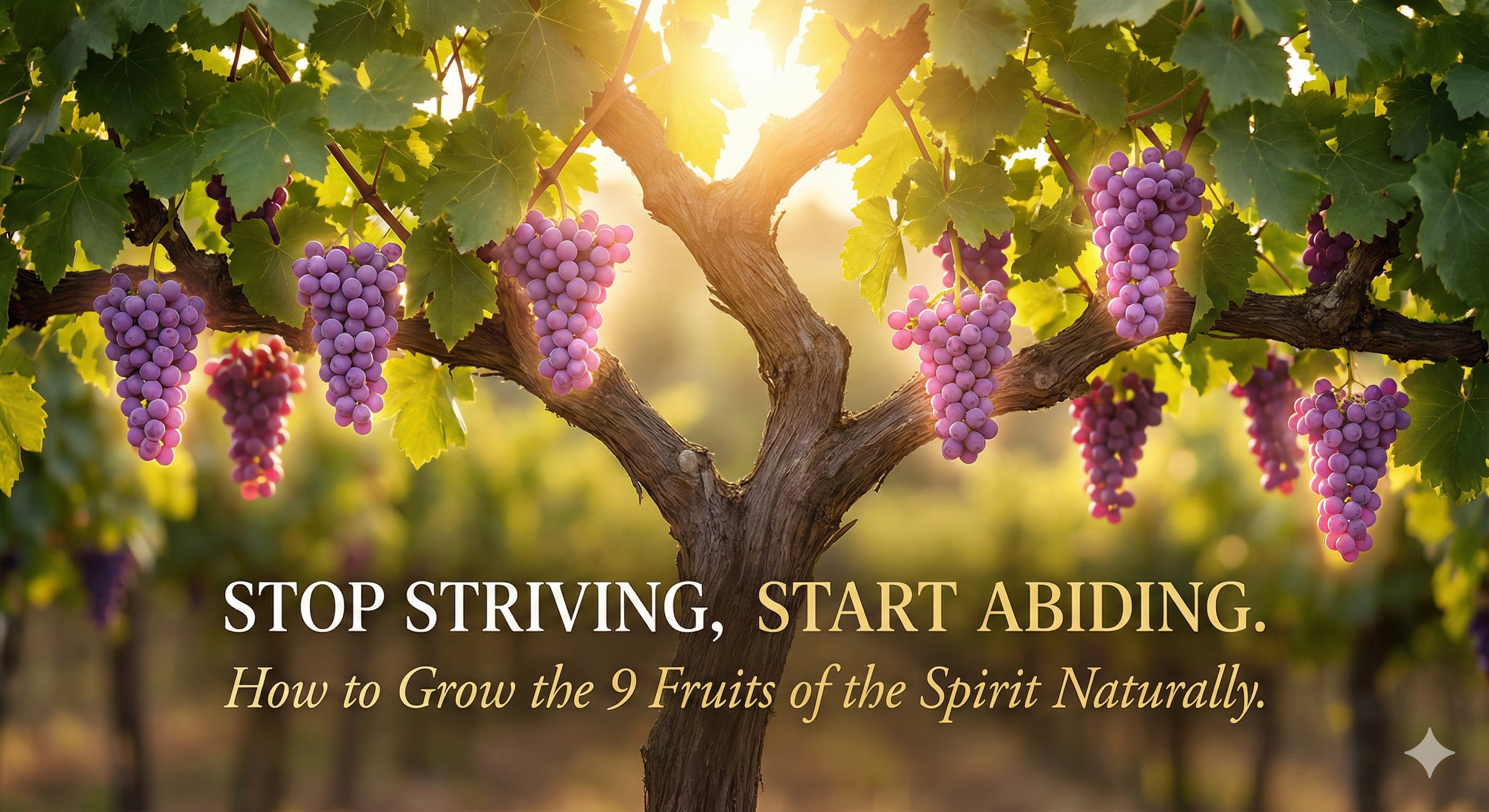
If you have ever tried to become more patient by gritting your teeth, or more loving by sheer willpower, you already know the frustrating truth: spiritual growth does not come from trying harder. The fruits of the Spirit are not achievements we unlock through discipline alone. They are the natural overflow of a life connected to Christ -- qualities the Holy Spirit grows in us as we learn to abide in Him. Just as a branch does not strain to produce grapes but simply stays attached to the vine, our role is not to manufacture spiritual fruit but to remain rooted in the One who produces it.
This is why Paul's words in Galatians 5 are so liberating. When he lists the fruits of the Spirit, he is not handing us a self-improvement checklist. He is describing what a life surrendered to God naturally looks like from the inside out. Notice that Paul uses the word "fruit" in the singular, not "fruits." Love, joy, peace, patience, kindness, goodness, faithfulness, gentleness, and self-control are not nine separate goals to chase. They are one interconnected harvest -- different expressions of the same Spirit working in the same heart. Where the Spirit is at work, all of these qualities begin to emerge together.
In this guide, we will walk through each of the nine fruits of the Spirit, exploring what they mean, why they matter, and how you can cultivate them through daily meditation on Scripture. Whether you are just beginning to explore what the fruits of the Spirit look like in real life or you have been walking with God for decades, there is always deeper fruit to bear.
Understanding the Fruits of the Spirit
To understand the fruits of the Spirit, it helps to read them in context. In Galatians 5, Paul is writing to a church that was struggling with legalism on one side and license on the other. Some believers thought they needed to follow the Jewish law to be right with God. Others used their freedom in Christ as an excuse to live however they wanted. Paul's answer to both groups was the same: walk by the Spirit.
Earlier in the chapter, Paul lists what he calls the "works of the flesh" -- things like hatred, jealousy, rage, selfish ambition, and envy. These are what human nature produces when left to its own devices. But immediately after that sobering list, Paul pivots to the fruit of the Spirit. The contrast is deliberate. The works of the flesh are many and fragmented. The fruit of the Spirit is singular and unified. The flesh produces chaos. The Spirit produces wholeness.
These nine qualities are the marks of a life genuinely surrendered to God. They cannot be faked long-term. You can pretend to be patient for an afternoon, but only the Spirit can make patience a settled quality of your character. You can act kind when it is convenient, but Spirit-produced kindness shows up when it costs you something. The fruits of the Spirit are the evidence that Christ is not just someone you believe in but someone who lives in you.
The 9 Fruits of the Spirit: What Each One Means
Love (Agape)
Love is listed first because it is the foundation from which every other fruit grows. The Greek word Paul uses is agape -- not romantic love, not friendship love, but the deliberate, selfless, sacrificial love that God Himself embodies. This is the love that sent Christ to the cross for people who did not deserve it. It is not a feeling you wait to have. It is a decision to seek the good of another person regardless of what they have done or what it costs you.
Agape love is the soil in which joy, peace, patience, and every other fruit takes root. Without love, patience becomes cold tolerance. Without love, kindness becomes mere politeness. Without love, self-control becomes rigid moralism. When the Spirit fills your heart with genuine love for God and for others, everything else begins to fall into place. This is why Jesus said the greatest commandment is to love God with all your heart and to love your neighbor as yourself -- because love is the root system of the entire spiritual life.
Every expression of spiritual fruit is ultimately an expression of love. Joy is love celebrating. Peace is love resting. Patience is love enduring. As you meditate on this fruit, ask yourself: Where in my life am I trying to produce the other fruits without first being rooted in love? Where do I need to receive God's love more deeply so I can give it more freely?
Joy (Chara)
Joy and happiness are not the same thing. Happiness depends on what happens to you. Joy depends on who lives in you. The Greek word chara describes a deep, settled gladness that is anchored not in circumstances but in the unchanging character of God. This is why the apostles could sing hymns in prison and why believers throughout history have faced persecution with inexplicable peace. Their joy was not rooted in their situation. It was rooted in their Savior.
This does not mean that Spirit-filled people walk around smiling through every hardship, pretending everything is fine. Biblical joy is honest. It weeps with those who weep. It acknowledges pain and loss. But underneath the tears, there is a bedrock confidence that God is good, that He is in control, and that the story does not end with suffering. Joy is what remains when happiness is stripped away and you discover that Christ is still enough.
James even writes that we should "consider it pure joy" when we face trials, because testing produces perseverance (James 1:2-3). This is not masochism. It is the recognition that God uses difficulty to deepen our character and our dependence on Him. As you reflect on this fruit, consider: Is my sense of well-being dependent on my circumstances, or is it anchored in something deeper? What would it look like to find my joy in God's presence rather than in my situation?
Peace (Eirene)
The peace Jesus offers is fundamentally different from anything the world can provide. The world's peace depends on the absence of conflict. Jesus' peace exists in the middle of it. The Greek word eirene carries the sense of wholeness, completeness, and inner harmony -- not because everything around you is calm, but because the One who holds all things together holds you.
Jesus spoke these words to His disciples on the night before His crucifixion. Everything was about to fall apart. Yet He offered them peace -- His peace. Not a peace that removes storms, but a peace that steadies the soul in the middle of them. This is the peace that Paul describes as surpassing all understanding, guarding our hearts and minds in Christ Jesus (Philippians 4:7). It does not always make logical sense. It simply holds.
The fruit of peace also extends outward. Spirit-filled people become peacemakers, not just peace-keepers. They do not avoid conflict at all costs, but they carry a calming presence into tense situations because the Prince of Peace lives in them. Ask yourself: Am I looking for peace in my circumstances, or am I receiving it from Christ? Where is God inviting me to be a peacemaker this week?
Patience (Makrothumia)
The Greek word for patience, makrothumia, literally means "long-tempered" -- the opposite of short-tempered. It describes the ability to endure difficult people and difficult circumstances without giving in to anger, despair, or revenge. This is not passive resignation. It is an active trust that God is working even when you cannot see it, that His timing is better than yours, and that He will make all things right in the end.
Patience is one of the most counter-cultural fruits of the Spirit. We live in a world of instant everything -- instant delivery, instant answers, instant gratification. The idea that spiritual growth takes time, that relationships require long-suffering, that waiting on God is an act of worship -- these truths cut against the grain of modern life. But God Himself is described as "slow to anger and abounding in love" (Psalm 103:8). When the Spirit produces patience in you, He is making you more like your Father.
Patience also has a deeply relational dimension. Paul writes to the Colossians, "Bear with each other and forgive one another if any of you has a grievance against someone" (Colossians 3:13). Bearing with people who are difficult, who disappoint you, who grow slowly -- this is where patience is forged. Reflect on this: Where am I demanding instant results from God or from the people around me? What would it look like to trust God's timing in this season of my life?
Kindness (Chrestotes)
Kindness is love in action. It is not just a warm feeling toward others but active goodwill expressed through tangible words and deeds. The Greek word chrestotes describes a quality that is useful, beneficial, and pleasant -- a disposition that looks for ways to bless others. God Himself is described as kind, even toward the ungrateful and wicked (Luke 6:35). His kindness is what leads people to repentance (Romans 2:4). When we are kind, we are reflecting the very heart of God to the world.
There is a temptation to see kindness as weakness -- as something soft and sentimental. But biblical kindness requires tremendous strength. It means being kind to the person who has wronged you. It means speaking gently when you have every right to be harsh. It means going out of your way for someone who cannot repay you. Kindness is not naivete. It is the deliberate choice to treat others the way God has treated you.
Kindness is also one of the most visible fruits of the Spirit. People may not understand your theology, but they will notice when you are consistently, genuinely kind. It opens doors that arguments never could. As you meditate on this fruit, ask: Who in my life needs an unexpected act of kindness this week? Where am I withholding kindness because I feel someone does not deserve it?
Goodness (Agathosune)
Goodness goes beyond kindness. While kindness is warmth and generosity toward others, goodness is moral excellence -- a deep commitment to doing what is right, even when it is costly or unpopular. The Greek word agathosune carries a sense of active righteousness, a goodness that does not just avoid evil but actively pursues what is good and true. This is the kind of goodness that confronts injustice, stands up for the vulnerable, and tells the truth in love even when it would be easier to stay silent.
Jesus embodied this kind of goodness. He was not merely nice. He overturned tables in the temple when worship was corrupted. He spoke hard truths to religious leaders who were leading people astray. He also wept at a friend's grave and welcomed children into His arms. Goodness is not rigid moralism. It is the full expression of a heart aligned with God's character -- fierce in its commitment to justice and tender in its compassion for the broken.
Paul encourages believers, "Let us not become weary in doing good, for at the proper time we will reap a harvest if we do not give up" (Galatians 6:9). Goodness is a long game. It requires perseverance. Consider: Where am I settling for "nice" when God is calling me to be truly good? Is there a situation where doing the right thing will cost me, and am I willing to pay that price?
Faithfulness (Pistis)
Faithfulness is the quality of being reliable, trustworthy, and steadfastly loyal over time. The Greek word pistis can also be translated as "faith," and there is a beautiful connection between the two meanings. A faithful person is someone whose faith shows up in their consistency -- someone whose word can be trusted, whose commitments are kept, and whose character does not change depending on who is watching.
Our God is the ultimate model of faithfulness. His mercies are new every morning. He keeps every promise. He never abandons His people. When the Spirit produces faithfulness in us, He is shaping us into people who reflect this aspect of God's character. Faithfulness in small things -- showing up when you said you would, following through on a commitment, being the same person in private that you are in public -- these are the proving grounds where the Spirit does His quiet, powerful work.
Jesus told a parable about servants entrusted with different amounts of money. To the ones who were faithful, the master said, "Well done, good and faithful servant! You have been faithful with a few things; I will put you in charge of many things" (Matthew 25:21). Faithfulness in the small and unseen things is what qualifies us for greater responsibility. Ask yourself: Am I faithful in the small commitments of my daily life? Where has God placed me right now that requires steady, quiet faithfulness?
Gentleness (Prautes)
Gentleness is one of the most misunderstood fruits of the Spirit. The Greek word prautes is often translated as "meekness," but meekness is not weakness. It is strength under control. Think of a powerful horse that has been trained to respond to the lightest touch of the reins. All that power is still there, but it is submitted, directed, harnessed for good. That is gentleness -- the ability to be strong without being harsh, to be confident without being arrogant, to correct without crushing.
Jesus is the perfect picture of gentleness. He was the most powerful person to ever walk the earth -- the One who spoke the universe into existence. Yet He held children in His arms, washed His disciples' feet, and wept over Jerusalem. He could have called ten thousand angels to rescue Him from the cross. Instead, He submitted to suffering for the sake of love. His gentleness was not the absence of power. It was power fully surrendered to the Father's will.
In a world that equates loudness with strength and aggression with leadership, gentleness is quietly revolutionary. A gentle word can disarm an argument. A gentle presence can bring peace to a room full of anxiety. Paul urges believers to "be completely humble and gentle; be patient, bearing with one another in love" (Ephesians 4:2). Reflect on this: Do I equate gentleness with weakness? Where in my relationships could I bring strength under control rather than strength on display?
Self-Control (Egkrateia)
Self-control is the final fruit listed, and it serves as a kind of capstone. The Greek word egkrateia means "mastery from within" -- the ability to govern your impulses, desires, and reactions through the Spirit's power. This is not white-knuckle willpower fueled by guilt or fear. It is a deep, Spirit-empowered capacity to say no to what harms you and yes to what God has for you.
The image from Proverbs is vivid: a person without self-control is like a city with broken walls. In the ancient world, walls were a city's primary defense. Without them, the city was vulnerable to every attack. In the same way, a life without self-control is exposed -- vulnerable to temptation, easily overwhelmed by emotion, and unable to protect what matters most. But when the Spirit builds self-control in you, He is rebuilding your walls, restoring your defenses, giving you the strength to stand firm.
It is significant that Paul lists self-control as a fruit of the Spirit rather than a work of the flesh. We do not produce self-control by trying harder. We receive it by yielding more fully to the Spirit's work in us. Every time you choose to pause instead of react, to pray instead of panic, to surrender a craving to God instead of giving in, you are cooperating with the Spirit's work of building self-control in your life. Ask yourself: Where in my life do I feel most out of control? Am I trying to manage this area in my own strength, or am I inviting the Spirit to do what only He can do?
How to Cultivate the Fruits of the Spirit Through Meditation
Understanding the fruits of the Spirit is important, but knowledge alone does not produce transformation. The fruit grows as we position ourselves in the presence of God. Here are five practical ways to cultivate the Spirit's fruit through daily meditation on Scripture.
1. Abide Before You Act
Jesus made this beautifully simple in John 15: "Remain in me, as I also remain in you. No branch can bear fruit by itself; it must remain in the vine. Neither can you bear fruit unless you remain in me" (John 15:4). Before you rush into your day, spend time connected to the vine. Read Scripture. Sit in God's presence. Let His Word settle into your heart before the demands of the day crowd it out. Fruit-bearing starts not with effort but with abiding.
2. Focus on One Fruit at a Time
Rather than trying to grow in all nine areas at once, spend a week meditating on a single fruit of the Spirit. Read the scriptures associated with it. Notice where it shows up in the life of Jesus. Pay attention to the moments in your day where that particular fruit is needed. By the end of nine weeks, you will have walked through the entire list with depth and intentionality rather than rushing through it superficially.
3. Pray for the Spirit's Work
You cannot produce the fruit of the Spirit any more than a branch can produce fruit apart from the tree. But you can ask. Pray specifically: "Holy Spirit, grow patience in me today. Show me where I am relying on my own strength instead of yielding to Yours." The Spirit loves to answer prayers that align with God's will, and producing His fruit in your life is very much His will.
4. Look for Daily Opportunities
Once you are focused on a particular fruit, you will start noticing opportunities everywhere. If you are meditating on kindness, you will see chances to be kind that you would have missed before. If you are focused on patience, you will recognize the moments that test it. This is not coincidence. It is the Spirit opening your eyes to the curriculum He has designed for your growth. Lean into those moments instead of avoiding them.
5. Use Scripture Meditation as Your Daily Practice
A consistent daily practice of meditating on Scripture is the single most effective way to position yourself for spiritual fruit. The Faith app is designed to help you do exactly this -- guiding you through personalized scripture meditation sessions that help you dwell deeply on God's Word. When you meditate on passages like Galatians 5:22-23, the Spirit uses that time to plant seeds that bear fruit in every area of your life.
The fruits of the Spirit are not produced by human effort. They are the natural harvest of a life rooted in Christ. Your job is not to manufacture fruit but to stay connected to the vine.
Conclusion
The fruits of the Spirit are the evidence of a transformed life. They are what the world sees when Christ lives in us -- not perfection, but a steady, undeniable change that no amount of self-help or moral effort could produce. Love that sacrifices. Joy that endures. Peace that does not make sense. Patience that outlasts provocation. Kindness that surprises. Goodness that acts. Faithfulness that shows up. Gentleness that disarms. Self-control that holds steady. These are the marks of the Spirit's presence, and they are available to every believer who learns to abide in Christ.
If you want to see these qualities grow in your life, begin today. Open Galatians 5:22-23 and sit with it. Do not rush past it. Let each word sink in. Ask the Spirit which fruit He wants to develop in you right now. Then watch for it -- in your conversations, your reactions, your quiet moments, your hardest days. The vine is faithful. If you stay connected, the fruit will come.