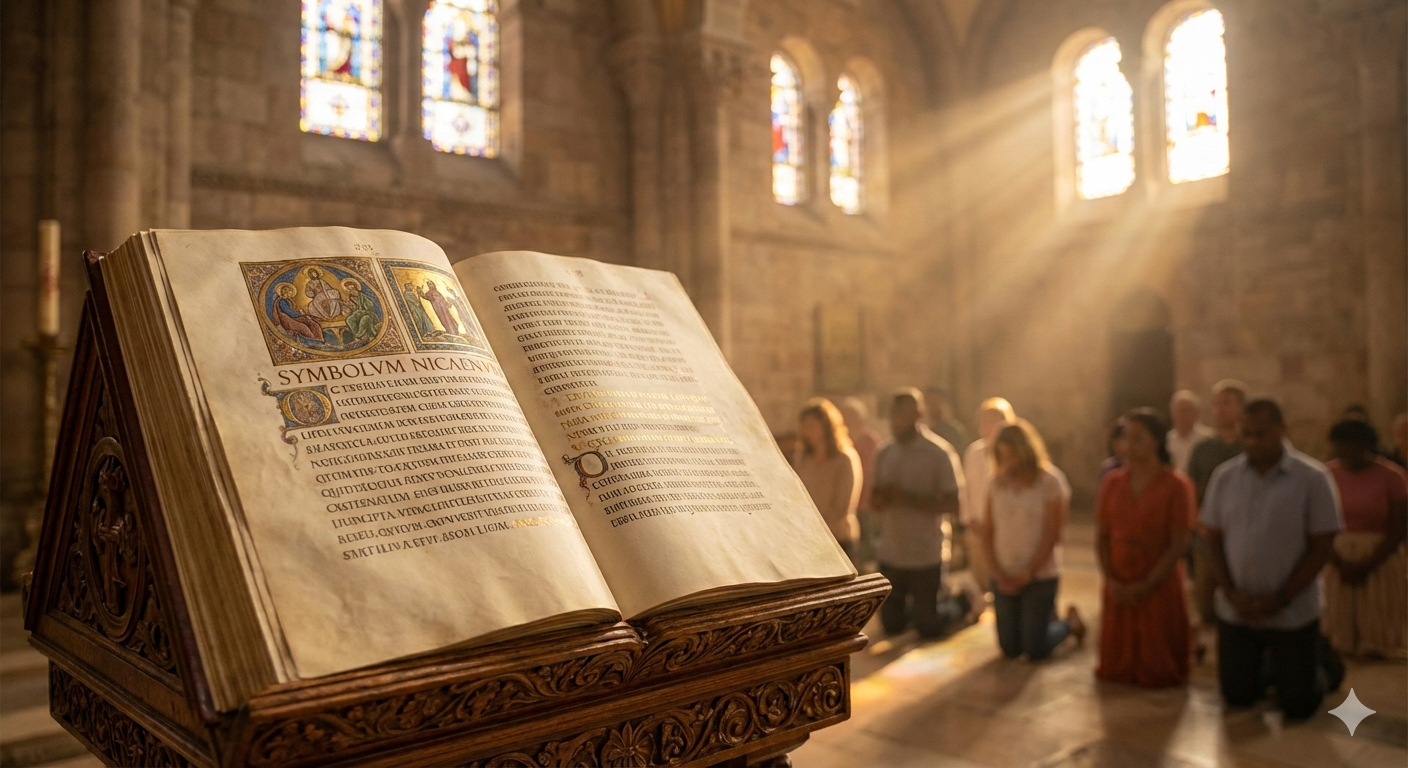
For nearly 1,700 years, Christians around the world have recited the Nicene Creed as a declaration of their core beliefs. Whether you hear it in a grand cathedral, a small country church, or during personal devotions, this ancient statement of faith continues to unite believers across denominations and generations. But what exactly is the Nicene Creed, and why does it still matter for Christians today?
Understanding the Nicene Creed opens a window into the foundations of Christian theology and connects us with believers throughout history who have confessed the same truths. In this guide, we'll explore its origins, break down its meaning phrase by phrase, and discover how you can incorporate this timeless creed into your prayer and meditation practice.
What Is the Nicene Creed?
The Nicene Creed is a formal statement of Christian belief that summarizes the essential doctrines of the faith. It was originally formulated at the First Council of Nicaea in 325 AD and later expanded at the First Council of Constantinople in 381 AD. The creed addresses the nature of God as Trinity—Father, Son, and Holy Spirit—and affirms key beliefs about creation, salvation, and the church.
The word "creed" comes from the Latin "credo," meaning "I believe." When Christians recite the Nicene Creed, they are personally affirming the central truths that have defined Christianity since its earliest centuries.
The Historical Context
The Nicene Creed emerged during a period of theological controversy in the early church. A teacher named Arius was spreading the belief that Jesus was a created being, not fully divine. This teaching threatened the core of Christian salvation—if Jesus were not truly God, how could He save humanity from sin?
Emperor Constantine called church leaders together at Nicaea (in modern-day Turkey) to settle this dispute. The resulting creed firmly established that Jesus Christ is "of one Being with the Father"—truly and fully God. This wasn't an invention of new doctrine but a clarification of what Christians had always believed based on Scripture.
The Nicene Creed: Line by Line
Let's examine each section of the Nicene Creed and understand its meaning for our faith:
Belief in God the Father
"We believe in one God, the Father Almighty, Maker of heaven and earth, and of all things visible and invisible."
The creed begins by affirming monotheism—there is only one God. He is identified as Father, emphasizing His relationship to the Son and to us as His children. He is Almighty, possessing all power, and is the Creator of everything that exists, both the physical world we can see and the spiritual realm we cannot.
Belief in Jesus Christ
"And in one Lord Jesus Christ, the only-begotten Son of God, begotten of the Father before all worlds; God of God, Light of Light, very God of very God; begotten, not made, being of one substance with the Father, by whom all things were made."
This section directly counters the Arian heresy. Jesus is not a created being but is eternally begotten of the Father—distinct in person but identical in divine nature. The phrase "of one substance" (Greek: homoousios) became the theological anchor that preserved orthodox Christianity.
"Who, for us men and for our salvation, came down from heaven, and was incarnate by the Holy Spirit of the virgin Mary, and was made man; and was crucified also for us under Pontius Pilate; He suffered and was buried; and the third day He rose again, according to the Scriptures; and ascended into heaven, and sits on the right hand of the Father; and He shall come again, with glory, to judge the living and the dead; whose kingdom shall have no end."
The creed then traces the gospel story: the incarnation, crucifixion, resurrection, ascension, and promised return of Christ. Each phrase is grounded in Scripture and affirms the historical reality of salvation.
Belief in the Holy Spirit
"And I believe in the Holy Spirit, the Lord and Giver of Life; who proceeds from the Father and the Son; who with the Father and the Son together is worshipped and glorified; who spoke by the prophets."
The Holy Spirit is not merely an impersonal force but is Lord, worthy of worship alongside the Father and Son. He is the source of spiritual life and the one who inspired the prophets to speak God's Word.
Belief in the Church
"And I believe in one holy catholic and apostolic Church. I acknowledge one baptism for the remission of sins; and I look for the resurrection of the dead, and the life of the world to come. Amen."
The word "catholic" here means "universal," not a specific denomination. The creed affirms that there is one true church spanning all times and places, founded on the apostles' teaching. It concludes with hope in the resurrection and eternal life.
Why the Nicene Creed Matters Today
In an age of religious confusion and doctrinal drift, the Nicene Creed provides several important benefits for believers:
- Theological Clarity: It defines the essential beliefs that distinguish Christianity from all other worldviews
- Historical Connection: Reciting it joins us with nearly two millennia of faithful believers
- Unity Across Denominations: Catholics, Orthodox, and most Protestant churches affirm the Nicene Creed
- Protection Against Error: It guards against ancient heresies that continue to resurface in modern forms
- Devotional Depth: Each phrase provides rich material for meditation and prayer
Using the Nicene Creed in Prayer and Meditation
The Nicene Creed isn't just for formal church services—it can become a powerful part of your personal devotional life. Here are ways to incorporate it into your spiritual practice:
Morning Declaration: Begin your day by reciting the creed as a reminder of who God is and what He has done. Let each phrase focus your mind on eternal truths before the day's demands take over.
Phrase-by-Phrase Meditation: Take one section of the creed each day and meditate on it deeply. Ask yourself: What does this mean? How does it affect my life? What Scripture passages support this truth?
Prayer Prompts: Use each statement as a launching point for prayer. For example, "Maker of heaven and earth" can lead to prayers of thanksgiving for creation and requests for God's care over His world.
Combating Doubt: When doubts arise, return to the creed. Its clear, confident statements can anchor your faith during spiritual storms.
The Nicene Creed and Scripture
Every line of the Nicene Creed is rooted in Scripture. The church fathers who wrote it were not inventing new ideas but summarizing biblical teaching. Here are some key Scripture connections:
- "One God, the Father Almighty" - Deuteronomy 6:4; 1 Corinthians 8:6
- "Maker of heaven and earth" - Genesis 1:1; John 1:3
- "Only-begotten Son of God" - John 3:16; Hebrews 1:5
- "Of one substance with the Father" - John 10:30; Colossians 2:9
- "Incarnate by the Holy Spirit of the virgin Mary" - Luke 1:35; Matthew 1:18-20
- "Crucified under Pontius Pilate" - Matthew 27; Mark 15; Luke 23; John 19
- "Rose again the third day" - 1 Corinthians 15:4
- "Sits at the right hand of the Father" - Hebrews 1:3; Acts 7:55-56
- "Shall come again to judge" - Acts 1:11; 2 Timothy 4:1
Conclusion
The Nicene Creed is far more than an ancient formula—it's a living confession of faith that Christians have treasured for centuries. By understanding and embracing this creed, we connect ourselves to the great cloud of witnesses who have gone before us and ground ourselves in the unchanging truths of the gospel.
Whether you're new to the faith or have walked with Christ for decades, the Nicene Creed offers a profound resource for deepening your understanding of who God is and what He has done for us in Christ. Consider making it part of your regular devotional practice, allowing its truths to shape your prayers, strengthen your faith, and unite you with Christians across time and around the world.